
In 2025, the law requires that foreign nationals staying in Poland have valid health insurance. This applies to both short visits and longer stays related to work, studies, or family reunification. Therefore, the insurance policy is not just a „piece of paper for the application,” but a real tool for protecting your life and your budget. Below you’ll find a practical guide: in what situations insurance is necessary, what types of coverage are accepted in 2025, and how to choose a plan that meets official requirements and is actually accepted at Polish medical facilities.
Why Do We Need Insurance at All? – A Practical Perspective
For a foreigner staying in Poland, access to health care may not be immediately clear. The system is based on two pillars: public (NFZ) and private. If you are not eligible for NFZ coverage (e.g., through employment or school), you are responsible for all medical costs. And that can amount to thousands of zlotys for a single visit to the emergency room with diagnostic tests, or tens of thousands of zlotys for hospitalization following an accident. Insurance ensures that:
- you don't have to pay for treatment out of pocket (within the limits and coverage amounts specified in the policy),
- The authorities will consider your application for a visa or residence card to be complete,
- You have an „immediate” action plan for emergencies—a hotline number, locations within the network, and a procedure for reporting an incident.
When is insurance mandatory for a foreign national?
The requirement to have insurance stems from immigration law and the practices of government agencies. In 2025, this applies in particular to:
- applying for a visa (short-term and long-term),
- submitting an application for a temporary or permanent residence permit (and picking up a residence card),
- taking a legal job (the employer reports this to the National Health Fund, but you often have to show your insurance policy first),
- start of studies (voluntary National Health Fund coverage or private insurance),
- longer family stays.
For short tourist visits, you are required to have at least medical expense insurance (KL), which covers sudden illnesses and accidents and is recognized when crossing the border.
Practical conclusion: In most real-life situations, without a valid insurance policy, it will be difficult to complete the necessary paperwork and navigate the Polish healthcare system safely. You can read more about how this document „works” within the procedures in the guide: Health Insurance and the Residence Card – Key Formalities.
What types of policies are accepted in 2025?
Public Health Insurance through the National Health Fund (NFZ)
If you work under an employment contract, your employer will register you with ZUS, and you will be entitled to benefits under the National Health Fund (NFZ). Students can enroll in the NFZ on a voluntary basis. The advantages include extensive coverage and relatively low costs; the disadvantage is the long wait times for certain specialists and tests, which are typical of the public sector.
Private Health Insurance for Foreigners
It provides prompt consultations, comprehensive diagnostics, and hospitalization within a network of partner facilities, as well as services in foreign languages. Basic packages (emergencies + primary care physician) and extended packages (diagnostics, rehabilitation, often conservative dentistry, telemedicine) are available. This is the preferred option for stays lasting several months, when time and comfort are important.
Medical Expense Insurance (KL)
Standard coverage for short stays and visa requirements. It typically covers sudden illnesses, outpatient treatment, hospitalization, medical transport, and emergency rescue. This is a good minimum „to start with” and while traveling, but for a long-term stay, it’s worth considering a more comprehensive plan than a standard tourist KL policy.
Formal Requirements – What Must a Visa and Residence Card Policy Include?
Provincial offices and consulates emphasize that the insurance policy must:
- was valid for the entire declared length of stay (without „holes”),
- included the territory of the Republic of Poland,
- covered the actual medical costs outpatient and inpatient and medical transport,
- was sufficiently high insurance coverage amount (For tourist options, the minimum is assumed to be 30,000 EUR; for longer stays, higher limits are recommended).
It is equally important to have a legible copy of the policy (PDF) and to be able to present the document in a language accepted by the authorities. For stays lasting several months, consider a plan specifically designed for a „residence card,” featuring cashless billing at Polish medical facilities and easy renewal of coverage.
Scope of Coverage – What Should Be Included in the General Terms and Conditions?
A practical insurance policy combines what government agencies require with what you need in your everyday life. Check to see if the General Insurance Terms and Conditions include:
- consultations with a primary care physician and quick access to specialists,
- diagnostics (lab, X-ray, ultrasound, CT, MRI),
- hospitalization and emergency procedures,
- emergency medical services i transport within Poland and (in certain plans) return,
- rehabilitation after injuries,
- Medical Hotline and Customer Service in foreign languages.
Do you have any chronic conditions? Check to see if they’re covered (sometimes they require additional coverage or a waiting period). For families, pediatric packages, preventive care, and urgent conservative dental care are particularly useful.
You can read about exactly what's included in the packages and how broadly they can be used in the article: What benefits does health insurance for foreigners in Poland cover?.
Common Mistakes and How to Avoid Them
- Too short a protection period regarding the planned stay. The office verifies the dates.
- Insurance coverage amount is too low – Formally and practically, this poses a risk of additional payments.
- No coverage for medical treatment in Poland (a policy covering an unfavorable territory or a „nominal” policy).
- Chronic diseases not covered – Failure to extend coverage results in reimbursement denials.
- No proof of payment / insurance policy on hand – The application is being sent back for additional information, and costs at the hospital are rising.
A simple pre-purchase checklist: coverage area, amount, term, type of benefits, PDF document, and instructions for reporting claims.
How to Choose and Buy an Insurance Policy—A Step-by-Step Guide
- Specify the type and length of your stay. Short visit = KL; work/school/family = long-term plan (private ± NFZ).
- Gather the agency's requirements. Check the amount, the time frame, and the documents required for the application.
- Compare branch networks in your city and benefit limits.
- Please read the General Terms and Conditions and the exclusions. Be mindful of sports, alcohol, chronic illnesses, and pregnancy.
- Buy a policy online or through a broker. Download the PDF and save it on your phone; attach a printout to your application.
- Ensure uninterrupted protection. Renew on time; when your status changes, make sure there are no „gaps.”.
If you're looking for a solution tailored to „official requirements” and genuine protection, check out: Health Insurance for Foreigners in Poland.
Students, employees, families—different situations, different optimal solutions
- Undergraduate and graduate students: Usually, you can choose between voluntary NFZ coverage (with assistance from the university) or a private plan that includes rapid diagnostics. For residence permit applications, you often need the document right away—a private online policy provides an instant PDF.
- Employees: When an employment contract is signed, the employer registers the employee with the National Health Fund (NFZ). In practice, many people opt for an additional private health plan (for added comfort and faster access to specialists).
- Families: It’s worth checking whether you can add your spouse and children to the policy, as well as pediatric care and preventive care. It’s helpful to have a broker who can compare family plans.
You can find costs and examples of market quotes for 2025 here: How much will health insurance cost for a foreigner in Poland in 2025?.
What are the consequences of not having insurance?
Failure to have a valid insurance policy may result in:
- a refusal to issue or extend a visa,
- rejection of an application for a residence card,
- the inability to use the public health care system (when one is not enrolled in the National Health Fund),
- a necessity self-funding all medical and hospitalization costs.
Even a single hospital stay can exceed a student’s annual budget or an employee’s savings accumulated over several months. This risk can be easily minimized by choosing a policy that matches the duration and purpose of your stay and ensuring it remains in force.
What the authorities require—a brief reminder
- Date from–to The policy must correspond to the length of stay.
- The Territory of „Poland” – without any room for interpretation.
- Insurance Coverage Amount – no less than 30,000 EUR for tourist visas; for longer stays, a reasonably higher amount.
- Scope of Treatment – outpatient care, inpatient care, medical transport.
- Document – legible, preferably in Polish and English, ready to be included in the file.
You can find a complete list of procedural requirements and practical examples here: Health Insurance for Foreigners in Poland – Who Is Required to Have It and How Can You Get It?.
How does the policy work in an emergency?
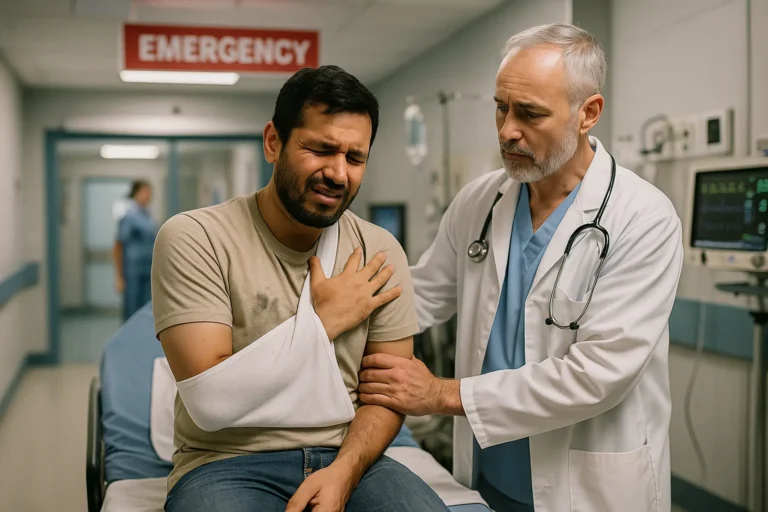
A real-life scenario: sudden abdominal pain → emergency room → diagnostic tests (blood tests, ultrasound, CT scan) → urgent procedure → hospitalization. If you have a valid insurance policy, the facility settles the bill with the insurer (either through direct billing or reimbursement). Without insurance—you’ll receive the bill.
You can read about the step-by-step process and which benefits are essential here: How does health insurance for foreigners in Poland work in emergencies?.
Where can I buy a policy so I don't have to „go back to the counter”?
You have three options, and each one makes sense depending on your situation:
- Insurance company: direct contact, complete documentation, takes time and often requires visits.
- Broker / agent: It will compare multiple offers, recommend family plans, and tailor the coverage to meet the agency's requirements.
- Online Shopping: the fastest—just a few minutes, payment by card or bank transfer, a PDF file available immediately to attach to your application, and easy renewals.
If you're looking for a simple, quick purchase and a ready-to-use document for your procedures, check out: Health Insurance for Foreigners in Poland.
Additional Usage Tips
- Keep your insurance policy on your phone (PDF) and keep the hotline number with you.
- Report Incidents in accordance with the instructions in the General Terms and Conditions—this is a prerequisite for a smooth settlement.
- Update Contact Information and your current address, if you move to a different city or change your phone number.
- Keep an eye on the grace period – Some benefits become available after a certain period following purchase.
- Pay attention to sports and physical work – sometimes they require risk extensions.
A Reasonable Budget and Real Protection
The price of an insurance policy is always a compromise between coverage and budget. The cheapest options may not meet all formal requirements or cover the actual costs of medical treatment. On the other hand, paying a little extra for a more comprehensive plan can pay for itself with the first major diagnostic test or a short hospital stay.
Final check questions before clicking „Buy”
- Is the policy term covers the entire planned stay Nonstop?
- Is this territory Poland, and is the sum insured sufficient?
- Is it within the scope? hospitalization, diagnostics, and transportation?
- Do you need extensions (chronic illnesses, pregnancy, sports)?
- Do you have PDF and registration instructions on hand?
If you answer „yes” to these questions, you’re ready to safely submit your application and live peacefully in Poland.





 Polish
 English
 Ukrainian
 Spanish
 Turkish
 Russian
 Vietnamese
 Indonesian